
Legacy software modernization

Modernize the software your business still depends on

Reduce technical debt. Lower modernization costs. Build for what’s next. Tevpro transforms critical legacy systems with AI-accelerated engineering.

How we can help

Legacy modernization expertise

View Application modernization

Application modernization

Modernize business-critical applications without disrupting the operations they support. We assess architecture, dependencies, and risk, then choose the path that creates value fastest.

  • Application assessment
  • Incremental refactoring
  • Platform reengineering
  • Managed transition planning

Cloud & platform migration

Move workloads to the right platform with a migration plan grounded in performance, security, cost, and operational realities, not a generic cloud checklist.

  • Cloud readiness
  • Replatforming
  • Infrastructure modernization
  • Cutover planning
View Legacy integration & API enablement

Legacy integration & API enablement

Extend the useful life of legacy systems by connecting them to modern applications, data platforms, and partner ecosystems through secure, durable integration layers.

  • API strategy
  • Integration architecture
  • System interoperability
  • Secure data exchange
View Data & database modernization

Data & database modernization

Make trusted data available where the business needs it while protecting integrity, continuity, and compliance across the systems that still run the operation.

  • Database migration
  • Data integration
  • Reporting modernization
  • Data quality controls
View AI-accelerated transformation

AI-accelerated transformation

Use AI-assisted discovery, code analysis, documentation, and test generation to reduce uncertainty and accelerate modernization, with engineers accountable for every production decision.

  • Codebase discovery
  • Documentation recovery
  • Test automation
  • Modernization acceleration

Choose the right path

Modernization does not have to mean starting over

The right approach depends on the system’s business value, technical condition, integration footprint, data quality, and the change the organization can absorb.

Extend

Stabilize what still works

Keep the parts of the system that support important work, then address the highest-risk failures first. This can include documentation, testing, security improvements, and targeted refactoring.

Connect

Add an integration layer

Expose reliable interfaces around older applications so data can move without forcing every dependent system to change at once.

Replatform

Move the workload deliberately

Update hosting, runtime, database, or deployment practices when the application can benefit from a modern operating environment without a full functional rebuild.

Replace

Rebuild only when the case is clear

A replacement can make sense when the existing system cannot meet the business need, the cost of keeping it is too high, or the architecture prevents meaningful progress.

A phased approach

Make the next decision before committing to the whole journey

Large modernization programs go sideways when a team sets a destination before it understands the migration surface. Start with enough evidence to choose the next safe move.

Assess the estate

Inventory the application, data stores, integrations, scheduled work, reports, infrastructure, and business constraints. Capture the people and processes that hold missing context.

Set a modernization roadmap

Prioritize by business risk, dependency, value, and feasibility. Decide what can be stabilized, wrapped, migrated, refactored, or retired.

Prove the riskiest assumptions

Use a pilot or thin first release to test integration behavior, data mapping, operational fit, and the proposed technical direction before broad rollout.

Migrate in controlled phases

Plan validation, cutover criteria, rollback, and communication around the business calendar. Run old and new paths in parallel when the risk warrants it.

Validate and retire responsibly

Reconcile data, confirm critical workflows, monitor the new environment, and retire the old system only when the evidence supports it.

Legacy Modernization

Modernize what matters. Keep what works.

View all case studies
Read case study
Legacy system migration to the cloud case study image
Legacy Software ModernizationData Solutions

Modernizing a decades-old Microsoft Access database and banking application

A legacy modernization project focused on an aging Microsoft Access database and banking application.

Read case study
Medical company legacy modernization Microsoft Azure Cloud case study image
Legacy Software ModernizationData Solutions

Migrating legacy applications to Microsoft Azure

A case study on moving legacy applications to Azure while addressing security, performance, and disaster recovery needs.

Read case study
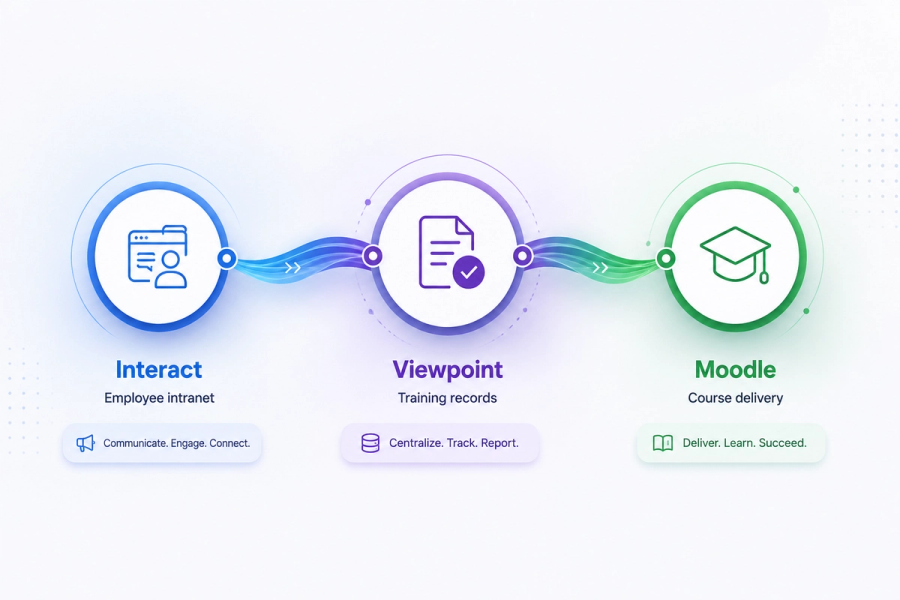
Integration diagram showing Interact, Viewpoint, and Moodle connected in a workflow.
API + Systems IntegrationsLegacy Software Modernization

Integrating systems without replacing the legacy platform

A systems-integration case study focused on connecting training and intranet platforms while preserving the systems underneath.

How fast can AI accelerate your legacy transformation?

Find out today!

Planning resources

Useful reading before you commit to a migration

Visit the blog
Hands using a stylus to check off items on a digital 'PLAN' checklist on a tablet.
Legacy Modernization

Legacy Data Migration Checklist: How to Move Critical Data Without Breaking Operations

Use this legacy data migration checklist to plan data mapping, cleansing, validation, testing, cutover, rollback, and post-migration reconciliation.

Yellow diamond-shaped road sign with a black wavy arrow pointing up, and the number 12.
Legacy Modernization

Legacy System Migration Strategy: A Practical 7-Step Framework

A practical framework for planning legacy system migration, protecting operations, and deciding when to replace, rebuild, or modernize in phases.

Many scattered colorful Lego bricks.
Legacy Modernization

Modernizing Legacy System Integrations Without a Risky Rewrite

A staged approach for replacing fragile point-to-point connections while protecting the business processes that still depend on the systems underneath.

FAQ

Questions teams ask before modernizing a legacy system

Legacy software modernization is the process of improving or replacing older applications, databases, and infrastructure so they are easier to maintain, integrate, secure, and scale.