
Tevpro insights
Make Legacy Applications AI-Ready Without Replacing Them
Expose one controlled business action from a legacy application before giving an AI agent access to the whole system.
Key takeaways
- AI readiness means exposing one reliable, authorized business operation, not granting the model database access.
- Place identity, validation, approvals, and idempotency in the integration layer.
- Modernize in stages; replace a system only when its cost and constraints justify it.
A legacy application can be AI-ready without being replaced. The useful question is not whether an agent can click through its screens. It is whether the business can expose a specific, reliable operation to an agent through a controlled interface. Start with a read, then a proposed change, then a reviewed transaction. That sequence preserves the system of record while improving how people work with it.
Workday's October 13 announcement shows where enterprise platforms are heading: it describes generally available tools and an agent harness designed to access HR and finance workflows under the platform's permissions and approvals. Its announcement illustrates the value of governing agent access at the business-operation layer, rather than giving a model direct access to underlying records.
What does AI-ready actually mean for an older system?
An AI-ready application has a way to locate relevant records, express a bounded business action, check that the caller is allowed to do it, validate the inputs, execute or reject the transaction predictably, and report the result. It does not require every part of the application to be rewritten as a microservice. It does require someone to understand where business rules live and how an incorrect action can be reversed.
Suppose an operations team keeps customer account changes in a long lived internal application. Staff can make a change through a supported screen, but there is no documented API. A general purpose agent with a database credential would bypass validation and leave operators unable to tell why a field changed. A safer design wraps the supported business process in an integration service, with tests against representative records and a clear owner for exceptions.
The first milestone is often not a write operation. Build a reliable read path, confirm that customer identifiers resolve consistently, and show the human reviewer which records and rules informed a recommendation. If the same customer appears under different identifiers in two systems, fix or explicitly map that relationship before any autonomous workflow.
Where should the integration layer sit?
Put an adapter or middleware service between the agent and the existing application. The agent asks for a named operation, such as `get_account_status` or `prepare_address_change`. The service maps identifiers, enforces field-level validation, checks authorization, invokes a supported backend transaction, and returns a structured outcome. Do not expose a general SQL console as an agent tool because the application lacks a convenient API.
Not every older system can offer a new HTTP endpoint directly. A queue consumer, supported batch interface, vendor service, or adapter around a stable application service may be safer than screen scraping. RPA can bridge a narrow interface when no better one exists, but it is brittle around changed screens, timing, and ambiguous errors. If an agent invokes RPA, the process still needs an idempotent request ID, reconciliation, and a human escape route.
The OWASP API Security Top 10 is a useful check on the adapter, especially for object-level authorization and authentication. An API being new does not make it safe. It must verify the agent's authority to act on this particular record and limit which properties may be changed. An internal network location is not a substitute for those checks.
A read-to-approved-write architecture
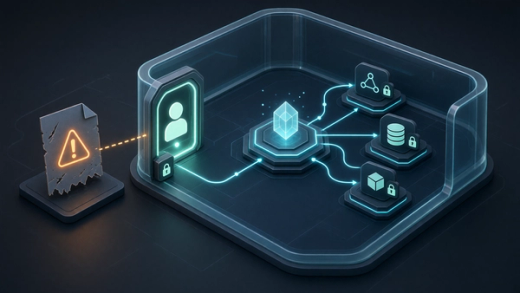
Picture five components: the agent's orchestration service; a read-only retrieval interface; an approval service; a narrow transaction adapter; and the legacy system of record. The request begins with a user or scheduled workflow that has a known identity. The retrieval interface returns only permitted fields. The agent explains a proposed change with the target ID, existing value, new value, and reason. The approval service binds a named person's decision to that exact proposal. The adapter validates the approval, checks the current record has not changed, executes once, and records the result.
If the record changed between proposal and approval, reject the action and re-read. If the adapter times out after sending a request, reconcile by the idempotency key before retrying. If an old system cannot reverse a transaction, require stronger approval before executing it. These are ordinary integration disciplines, but they matter more when an agent can generate many proposed actions quickly.
This is an architecture example, not a claim that Tevpro implemented a particular customer's workflow. The essential design choice is to keep the model out of the authorization decision. NIST's software-agent identity concept paper highlights questions around identifying, authorizing, and auditing agents. Those questions remain even if the old application only understands a service account; the adapter must map that account to a specific agent, initiating user, and approved operation.
Should we modernize or replace the application?
Modernize the boundary when the core application remains useful, its critical transactions can be tested, and a narrow integration can be operated safely. Replace components when an unstable interface, unsupported runtime, missing security controls, or untestable business logic make the adapter a permanent source of risk. Replacement should follow the business capability that needs to move, not a blanket rule that every old system is obsolete.
Microsoft's Strangler Fig pattern describes incremental replacement of old capabilities with new services. That pattern can coexist with an AI integration: expose one controlled capability now, measure its reliability, and replace only the parts whose constraints justify the work. Our legacy integration guide covers wider modernization choices. This article focuses on the added requirements when an agent is the caller.
Cost matters beyond the first build. Count adapter maintenance, vendor support, authentication changes, monitoring, licensing, and the effort to investigate failed transactions. A quick screen-automation pilot may be less expensive initially but more costly to maintain than a small stable API. Conversely, a full replacement for one modest workflow may be needless risk. The answer depends on interface quality, transaction volume, and the cost of an error.
A practical implementation roadmap
- Inventory the workflow: identify the owner, system of record, affected users, data sensitivity, and what a correct transaction looks like.
- Map business rules: document validation, duplicate detection, exceptions, rollback, and conflicting records with actual operators.
- Build a read-only interface: test identifier matching, field restrictions, freshness, and permission denials.
- Add proposals and approvals: show reviewers before-and-after values and bind approval to the precise action.
- Add one write operation: make it idempotent, auditable, and limited by record, field, threshold, and rate.
- Exercise failure paths: test a stale approval, missing data, timeout, duplicate request, revoked identity, and human recovery.
- Review outcomes: measure completion, rejected proposals, manual rework, reliability, and cost before widening scope.
If your applications span multiple data stores, the data solutions team can help map ownership and reliable access. For a specific modernization decision, bring Tevpro the workflow, the existing interface, and the failure that makes it hard to automate. Replacing the application can wait until the evidence supports it.
Sources
Why work with us
Why Tevpro?
Whether you’re a startup with a bold product idea or an established company seeking a stronger delivery partner, Tevpro delivers results. Our expert consultants specialize in building secure, scalable applications that simplify operations and drive real ROI.
FAQ
Frequently asked questions
Yes, if a reliable integration layer exposes specific data and business actions with authentication, validation, and auditability. The model should not bypass the application’s rules.