
Tevpro insights
Enterprise AI Agents Need an Operating Model, Not a Job Title
Before an AI agent touches a business workflow, decide who owns its work, what it may do, and how exceptions are reviewed.
Key takeaways
- Give an agent a defined task and human owner before giving it access.
- Treat read, propose, approve, and execute as distinct levels of authority.
- Keep action logs, exception handling, and rollback in the workflow, not in a prompt.
Enterprise AI agents can move work across applications, not just answer questions. But giving an agent a task does not make it an employee. It makes it a software actor whose access, decisions, and mistakes need a human owner. A production operating model defines what the agent may read, what it may propose, what it may change, and how a person can stop or correct it.
That distinction matters now because enterprise vendors are packaging identity and workflow controls around agents. Workday's October 13 announcement describes generally available Agent-Ready Tools, Data Cloud, Developer Agent, Custom Agents, and Agent Harness for HR and finance workflows. Those are vendor claims about its platform, not evidence that every customer deployment is safe or productive. The question for a business is more basic: who controls a specific agent on a Tuesday afternoon when the usual path fails?
What makes an AI agent different from a chatbot?
A chatbot usually returns information for someone to use. An agent may select a tool, retrieve a record, make a decision about the next step, and submit an action through an application. The boundary is not the model's sophistication; it is whether its output can affect a system of record. A well-written email is an answer. Creating a customer credit, changing an employee record, or updating an order is an action.
Many practical agents are only partly autonomous. They can gather context and draft a recommendation while a person authorizes the transaction. Calling every workflow fully autonomous overstates what is useful. The right level of independence depends on the cost of a mistake, how reversible the action is, and whether the underlying data can be trusted.
Who owns an agent's work?
Assign four roles before a pilot. A business owner defines the outcome and acceptable exceptions. A technical owner maintains integrations, tests, and rollback. A data owner determines what records the workflow can access. An approver authorizes sensitive actions. One person can wear several hats in a small company, but the responsibilities cannot be left to the agent's prompt.
The NIST identity and authority concept paper frames identification, authorization, auditing, and accountability as open architectural questions for software agents. It is a concept paper, not a certification standard or a claim that every vendor solves those questions. Teams should use the questions as a design test: can we identify this actor, trace its authority to a human sponsor, and revoke it without disabling unrelated work?
An agent should have its own identity where the environment supports it. Avoid a shared employee login or a permanent all-powerful API key. Microsoft's Entra Agent ID best-practice guidance addresses identity design, credentials, access, and monitoring in that ecosystem. The principle extends beyond Microsoft: separate the agent's identity from the person it serves and limit both the actor's scope and the delegated user's authority.
A useful authority ladder for enterprise AI agents
Start with four distinct levels. Promotion between levels is a product decision, not a prompt tweak:
- Observe: read a bounded set of records and explain the sources. No writes.
- Propose: prepare a specific change with the affected record, expected impact, and reason. Nothing is committed.
- Approve and execute: a named person reviews the exact proposed change; a restricted service performs it and records the approval.
- Limited autonomy: the agent can execute only a tested, low-impact operation inside explicit thresholds. Exceptions and unusual volume return to approval.
A customer-support agent might look up an order and prepare a credit recommendation. It should not be able to issue unlimited refunds because its initial prompt says to make customers happy. Thresholds, idempotency controls, and a separate write endpoint create a boundary the model cannot silently redefine. The business may later allow small, reversible credits; that change should have an owner and a measurable error rate.
How would this work across existing applications?
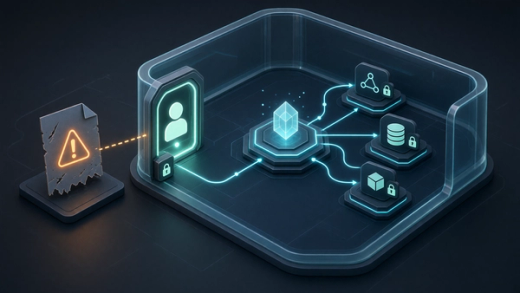
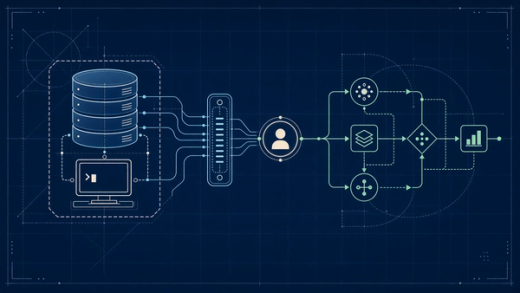
Consider an illustrative account-change workflow, not a claim about a Tevpro customer. A request arrives in the service queue. A workflow service identifies the requester, asks the agent to read the relevant CRM and billing records, and validates the returned identifiers. The agent prepares a proposed change with an explanation. A human sees the exact account, fields, before-and-after values, and business reason. After approval, a narrowly scoped API executes the change and writes an event containing the initiating request, agent ID, approver, target record, result, and any retry.
The agent is not allowed to write to the database directly. The integration service enforces required fields, record-level authorization, duplicate protection, and an expiration on approvals. If the billing system is unavailable, the workflow fails closed and sends the case to a queue. Retrying a transaction must not create the same change twice. This architecture is less glamorous than a universal AI coworker; it is also inspectable and repairable.
Our agent-ready enterprise architecture guide covers APIs and data integration. This article focuses on operating responsibility once those interfaces exist. For AI orchestration services, start by mapping one workflow rather than connecting every business system at once.
What should operators see after deployment?
Logs should answer who initiated the task, which agent version and tools ran, which records were read or changed, what approval was captured, and where the workflow ended. Record enough to reproduce a decision without copying unnecessary personal data into an observability system. Access to logs should also be restricted; an audit trail can become a second sensitive-data store.
Use operational measures that reflect work, not just model usage: completed tasks, approvals required, exceptions per task, reversals, manual rework, and time spent by reviewers. Track cost per completed business outcome, including tool calls and human review. A faster draft that creates more cleanup is not an efficiency gain.
Set a kill switch and test it. If a tool starts writing unexpected data, operators must be able to disable the agent's credential or endpoint, quarantine pending tasks, and reconcile attempted transactions. Incident ownership must be clear before an incident. For the security boundaries and human approval design in more detail, see our AI agent governance guide.
Where should a company start?
Choose a repetitive, bounded task with a clear input, an existing system of record, and an observable result. Document current manual handling and failure cases. In the first stage, let the agent read and propose while a person performs the action. Compare proposals against real decisions, test missing and conflicting records, then add a limited execution path with explicit review. Only consider greater autonomy after errors and reversals are understood.
Do not measure a pilot by how many agents exist. Measure whether one workflow is faster without losing control. If you are deciding how an agent should connect to the applications you already use, talk with Tevpro about the workflow, the systems involved, and the decisions that must remain human.
Sources
Why work with us
Why Tevpro?
Whether you’re a startup with a bold product idea or an established company seeking a stronger delivery partner, Tevpro delivers results. Our expert consultants specialize in building secure, scalable applications that simplify operations and drive real ROI.
FAQ
Frequently asked questions
An enterprise AI agent is software that uses a model to plan or select steps and invoke tools for a business task. Its permissions, tool access, and outcomes must still be controlled by ordinary enterprise systems.